-
 TTts-
-
 TTt-2
-
 TTt-
-
 TTtl-2
-
 TTtl-
-
 TTzh2
-
 TTzh
-
 TTz2
-
 TTz
-
 TTx
-
 TTw
-
 TTuy
-
 TTuw
-
 TTuu
-
 TTu
-
 TTts2
-
 TTts
-
 TTtl
-
 TTt2
-
 TTt
-
 TTsh2
-
 TTsh
-
 TTs
-
 TT-
-
 TToy
-
 TToo2
-
 TToo
-
 TTo2
-
 TTo
-
 TTn
-
 TTm
-
 TTlh2
-
 TTlh
-
 TTl2
-
 TTl
-
 TTk-
-
 TTk2
-
 TTk
-
 TTj
-
 TTiy
-
 TTii2
-
 TTii
-
 TTi
-
 TTh2
-
 TTh
-
 TTgh2
-
 TTgh
-
 TTg
-
 TTdz
-
 TTdl2
-
 TTdl
-
 TTd
-
 TTch-
-
 TTch
-
 TTb
-
 TTay
-
 TTaa
-
 TTa
-
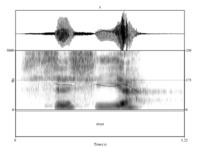
 DBRz
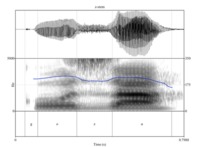
The voiced alveolar fricative z [z] in intervocalic position. It is voiced all the way through the sound. In this example, it is almost lenited to an approximant-like sound, and shows formant structure.
-
 DBRy
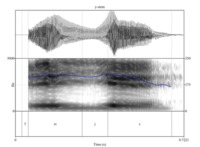
Note the falling tone on the final syllable, particularly distinguishable in this word spoken in isolation.
-
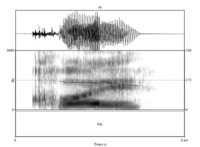
 NSDy
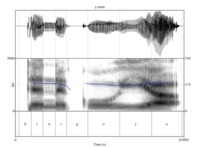
Another example of the palatal approximant y [j], intervocalically.
-
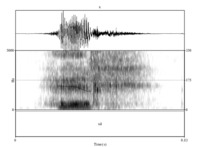
 DBRx
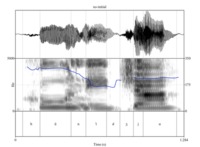
A voiceless velar fricative x [x] in word-initial position; in this example, it is realized as a glottal fricative [h].
-
 DBRwh
-
 DBRw
-
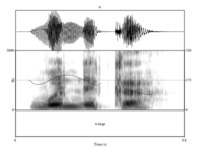
 NSDw
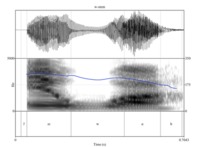
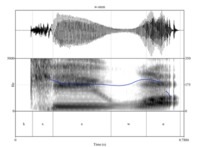
The voiced labio-velar approximant w [w] intervocalically. Note the velar affricate k [kx] in word-initial position.
-
 NSDuH
-
 LBDSuH
-
 CLDSuN
-
 DBRts
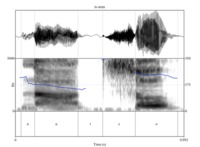
The voiceless alveolar affricate in intervocalic position. Note the lack of voicing and the length of the release (fricative) portion of the sound.
-
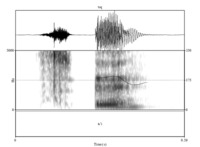
 DBRts-
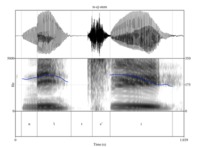
The alveolar ejective affricate in word-medial position. In this example, this sound is very similar to the alveolar ejective t’ [t’].
-
 NSDts-
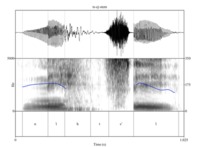
The alveolar ejective affricate ts’ [ts’] in stem-initial position, following h [h] in the coda of the previous syllable. Note the compression of the closure portion of the affricate and the duration of release. Also note the characteristic ejective pattern; there is a period of silence before the glottal release into the vowel.
-
 DBRtl
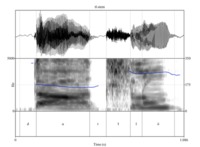
The voiceless lateral affricate in stem-initial, intervocalic position.
-
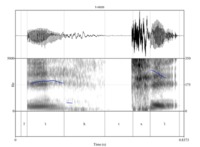 NSDt
This example of t [tx] is in stem-initial and word-medial position, following the glottal fricative h [h]. The closure and release periods of the t [tx] can be seen clearly in this example. The velar fricative offglide is an audible property of this sound.
-
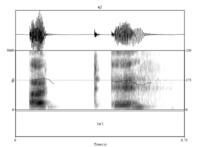
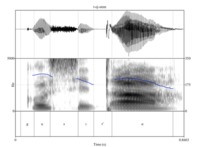 DBRt-
The ejective t’ [t’] in word-medial position. This is an example of a "weak" ejective. Unlike the characteristic t’ [t’] sound, in this example, the glottal release of the t’ [t’] ejective comes closely after its oral release, the release burst is followed closely by the onset of the vowel. This sound may be perceived as a voiced alveolar stop d [d].
-
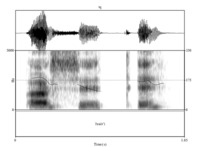
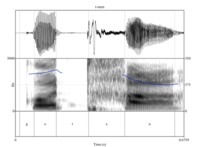 DBRt
The affricate t [tx] in word-medial and stem-initial position. Note the long length of the fricative release of the affricate. The vowel begins directly after the fricative release. Contrast this release with examples of the Tłį Chǫ aspirated alveolar affricate ts [tsʰ]; they have very similar profiles.
-
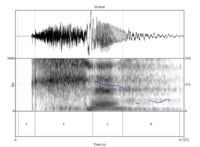 NSDtl
A word-initial example of the aspirated lateral affricate tł [tɬʰ] with a very long and strong fricative release.
-
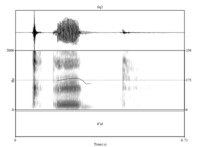
 DBRtl-
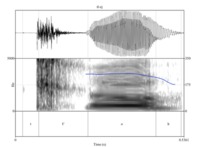
Another example of the lateral ejective affricate tł’ [tɬ’].
-
 NSDt-
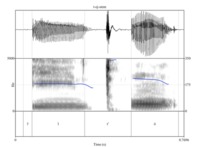
Another example of the alveolar ejective stop t’ [t’] in stem-initial position, between two vowels. This example shows the characteristic ejective profile, with the release of the stop visible halfway through the sound.
-
 NSDsh
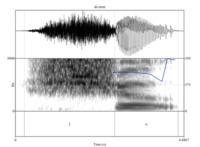
Another example of the voiceless post-alveolar fricative sh [ʃ] in word-initial position. This word was spoken in isolation. The initial consonant is quite long, but this gives a good idea of how strongly fricatives are articulated in the Dene languages as compared to European languages such as English.
-
 NSDs
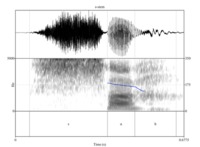
Another example of the voiceless alveolar fricative s [s] in word-initial position.
-
 CLDSr
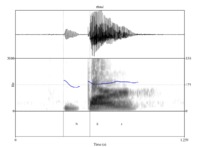
This token of r [ɹ] is in word-final position of a word spoken in isolation.
Note also the voicing in the initial b [b]; unaspirated stops in Dene Sųłine tend to be voiced.
-
 NSDr
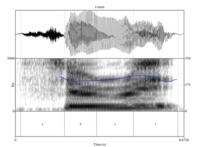
Contrast this example with the previous one. In this example, the r [ɹ] is intervocalic and strongly voiced. The characteristic dip of the third formant found in rhotic appproximants is visible in the spectrogram.
-
 DBRoNH
-
 DBRo
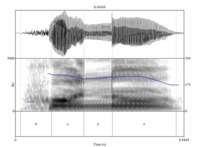
The tone on the first syllable falls only slightly but has the contour of a falling tone.
-
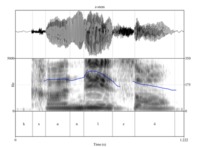 NSDoNH
Note that the high tone on the final syllable is lower than the high tone on the second syllable.
-
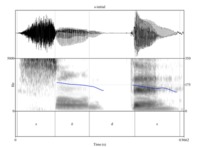 NSDoN
-
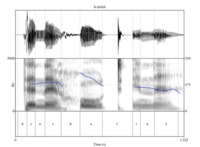 NSDoF
The mid back vowel o [o], long and with falling tone.
-
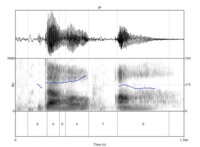 LBDSoH
-
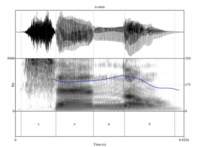 NSDn
The alveolar nasal between two vowels. Note the falling tone on the vowel in the final syllable; compare with the falling tone on a medial vowel in this example.
-
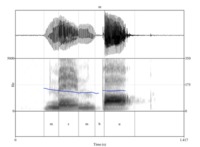 SSJMmb
-
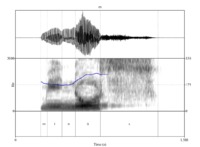 CLDSn
-
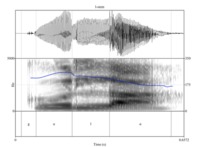 DBRl
The voiced lateral approximant in word-medial, stem-initial position. In this example, the sonorant-type structure is visible in the formants in the spectrogram.
-
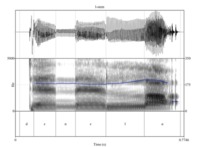 NSDl
Another instance of the voiced lateral approximant, this time word-medially but in stem-initial position.
-
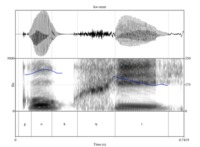 DBRkw
The voiceless labialized velar stop between two vowels. Note that the closure period is shorter than the labial release period. Also note the formant movement during the release. This is likely the second formant (no first formant is present), a result of the tongue position moving from the back (near the velum) to a more front position for the high front vowel i [i].
-
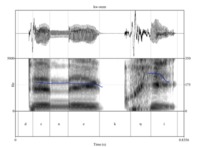 NSDkw
The voiceless labialized velar stop kw [kw̥] in stem-initial position. Like the plain velar stop k [kx], this stop has affricate-like properties.
-
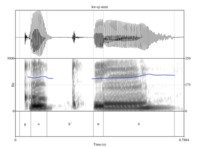 DBRkw-
An intervocalic example of kw’, which is realized in these examples as a characteristic velar ejective [k’] followed by a labio-velar glide [w]. In this example, the labio-velar glide clearly follows the ejective k’ [k’w]. Note also that the velar stop g [g] in initial position is voiceless.
-
 NSDkw-
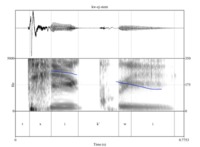
This is an interesting example of this sound. This sound is a variation on kw’ [kw̥’], but is articulated differently from the other ejective affricates. It is a velar ejective [k’] followed by a labial glide [w], as opposed to the labialized velar ejective [kw̥’] found in the preceding example. Note the characteristic ejective pattern in the waveform and spectrogram.
-
 DBRk
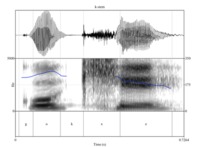
The velar affricate k [kx] between two vowels. The length and strength of the frication period is clear in the spectrogram and is a strong and audible property of the sound. Voicing continues briefly into the closure period of the sound, but the closure and release periods are voiceless. Note also that the initial velar stop g [g] is voiceless.
-
 NSDk
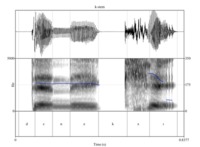
Another example of the velar affricate k [kx], in stem-initial position.
-
 DBRk-
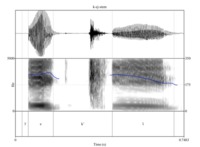
An intervocalic example of the velar ejective k’ [k’]. This sound has a long closure period, followed by a robust release burst which appears as a dark energy band. The glottal release occurs well after the release of the oral closure, resulting in the characteristic "period of silence" during the articulation of this sound. This also contributes to the sharp onset of the vowel. Note that the glottal stop in initial position is followed by a sharp onset of the vowel without any laryngealization; there is a very clean (non-laryngealized) transition from glottal closure to modal vowel. This is not an uncommon feature in Dene languages.
-
 NSDk-
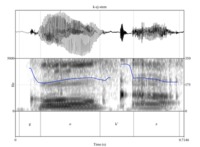
The velar ejective k’ [k’] in stem-initial position. The characteristic ejective pattern is visible in the waveform and the spectrogram.
-
 DBRj
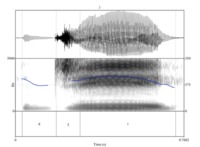
The voiced post-alveolar affricate j [dʒ] in word-initial position. It is voiced during both the closure and release portions of the sound.
-
 NSDj
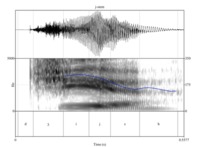
Another example of j [tʃ] in word-initial position, also voiceless. Note the way the fricative portion of the stop transitions into the vowel without any aspiration; contrast this with the aspiration of ch [tʃʰ].
-
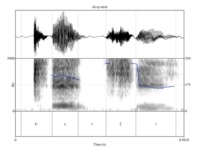
 DBRlh
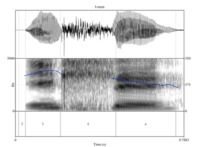
The voiceless lateral fricative ł [ɬ] in word-medial position.
-
 DBRiL
-
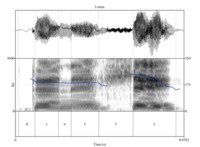 NSDlh
The voiceless lateral fricative ł [ɬ] in stem-initial position between two vowels. Note that the voicing of the vowel extends into the first part of the fricative.
-
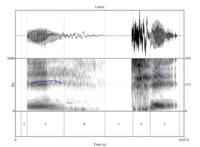 NSDi
The high front vowel nasalized and with high tone.
-
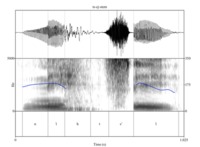 NSDi
A token with two instances of the high front vowel nasalized and with low tone. Note also the compression of the closure period of the ejective affricate ts’ [ts’] in stem-initial position following a closed syllable.
-
 LBDSiN
-
 LBDSiH
-
 CLDSiN
-
 CLDSiH
-
 DBRh
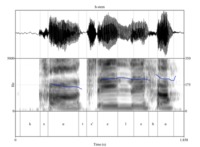
The glottal fricative h [h] in stem-initial position.
-
 DBRg
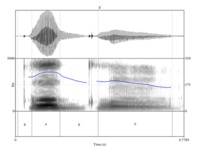
This word contains two examples of the velar plosive g [g]. In this token, the g is not voiced in initial position (as it is in the example above). However, the intervocalic g is strongly voiced. In all three example of the voiced velar stop g [g] on this page, the release burst is clearly visible as a spike in the spectrogram. The release bursts of velar fricatives often contain a double burst spike that is especially clear in the intervocalic example.
-
 NSDg
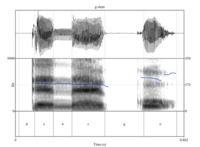
The unaspirated velar stop g [k] in stem-initial position, between two vowels. This is the position that would be most likely to show voicing if unaspirated stops were voiced; the lack of voicing in this position shows that the unaspirated stops of this dialect of North Slavey are voiceless sounds.
-
 DBRe
-
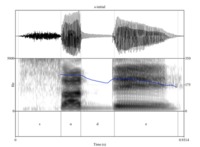 DBRe
-
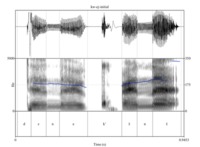 NSDeN
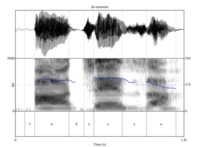
This example contains all short variants of the mid front vowel. All but one of these vowels are transcribed [ɛ], which is a lower variant of [e].
-
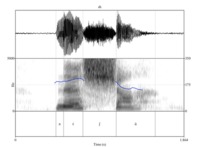 LBDSeH
-
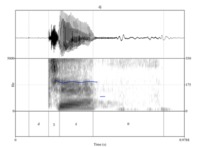 CLDSeH
-
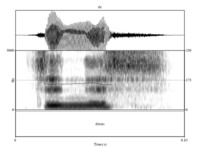
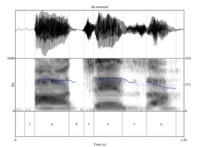 DBRdz
The alveolar affricate dz [dz] in intervocalic position. Compared to the last example, the affricate in this token is less voiced. Note the difference in the transition from the fricative portion of the sound to the vowel in this example as compared to that in the ts [tsʰ] examples.
-
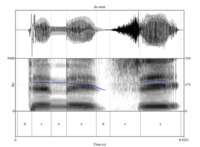 NSDdz
The unaspirated alveolar affricate dz [ts] in stem-initial, intervocalic position. The plosive closure portion of the affricate in this example is voiced. The fricative releases directly into the vowel with any period of aspiration.
-
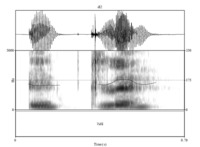
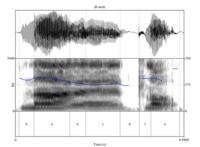 NSDdl
The unaspirated lateral affricate dl [tɬ] in stem-initial position. Note also the rhotic r, which is realized here as a well articulated central approximant [???].
-
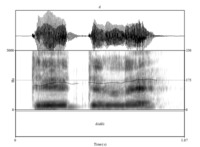
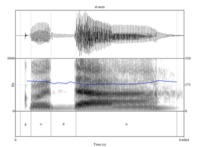 DBRd
The voiced alveolar stop d [d] in intervocalic position. The vowel begins immediately after the release of the stop. Notice the difference between the g [g] in initial position and the d [d] in intervocalic position; the initial g [g] is not voiced in this token. This kind of variation is not uncommon for voiced stops.
-
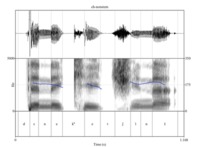 NSDch
Another example of the post-alveolar affricate ch [tʃʰ] between two vowels. This is also aspirated, which is visible in the transition of the fricative portion of the affricate into the vowel. Note also the k [kx], with its velar fricative release.
-
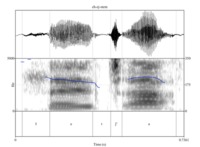 NSDch-
The post-alveolar ejective affricate ch’ [tʃ'] in stem-initial position between two vowels. The characteristic ejective pattern is less obvious here, and the sound is perceived as an aspirated affricate, instead of an ejective.
-
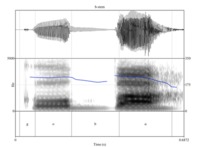 DBRb
The bilabial stop b [b] in this example is in medial position between two vowels. It is strongly voiced. Compare this to a North Slavey b [p], which is voiceless rather than voiced.
-
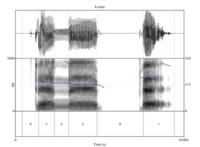 NSDb
The unaspirated bilabial stop b [p] in stem-initial position between two vowels. The sound is clearly voiceless in this example, as well.
-
 DBRa
-
 NSDaH
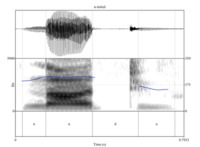
Note the intervocalic d [t], both for its duration and its voicelessness; compare this with the voicelessness of the other unaspirated stops b [p] and g [k].
-
 LBDSaN
-
 LBDSaH
-
 CLDSaN
-
 NSDzh
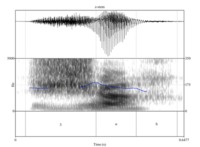
A fully voiced post-alveolar fricative zh [ʒ]. Full voicing in an obstruent in North Slavey, as we see here, is not common.
-
 DBRz
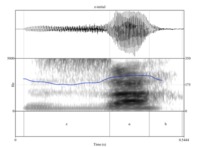
The voiced alveolar fricative z [z] is voiced all the way through the sound and contrasts with the voiceless s [s].
-
 NSDz
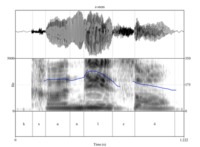
The voiced alveolar fricative z [z] in stem-initial position. The fricative is voiced only through the first part of the sound. Note the initial k [kx].
-
 LBDSz
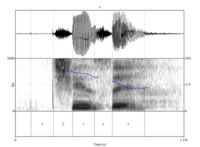
The voiced alveolar fricative z [z] between two vowels. In this token, it is only partially voiced. Contrast this with the voiceless alveolar fricative s [s] and with the fricative release of the affricate dz [dz] in word-initial position.
-
 CLDSz
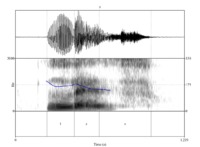
This is the voiced version of s [s]. It has semi-phonemic status; z [z] does not appear in word-initial position. In this example, it is only partially voiced.
-
 DBRy
-
 NSDy
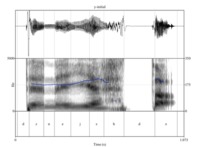
The palatal approximant y [j] intervocalically. Note also the two instances of d [t] in this example; both are voiceless. The length of the stem-initial d [t] in the final syllable is characteristic for stem-initial consonants.
-
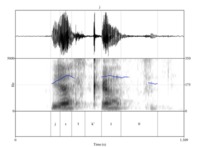 LBDSy
This is a palatal glide y in word initial position. Segmentation between this sound and the following mid front vowel is difficult and done mostly by formant structure.
-
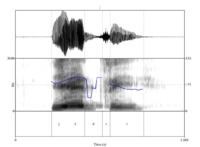 CLDSy
This token also contains the voiced alveolar affricate dz [dz] in stem-initial position; note the clear intervocalic voicing.
-
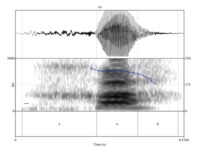 DBRx
A voiceless velar fricative in word-initial position.
-
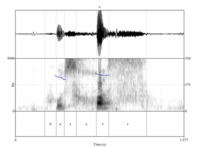 LBDSx
The phoneme x [x~h] in word-initial position. This sound is realized as a glottal fricative [h] rather than a velar fricative [x]; there is very little evidence of the oral constriction necessary for a velar fricative. Contrast this with the glottal fricative h [h] in this token, as well as with the release of the stops t [tx] and k [kx], which show strong velar frication.
-
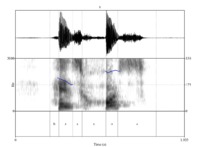 CLDSx
The voiceless velar fricative x [x] in stem-initial position, following s [s].
-
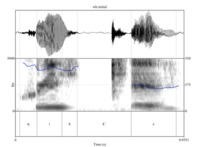 DBRwh
This token is voiceless, but still retains sonorant-type properties; a formant is still visible in the spectrogram.
-
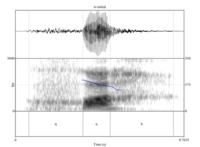 NSDwh
The voiceless labiovelar approximant wh [w̥]; contrast this sound with its voiced counterpart w [w].
-
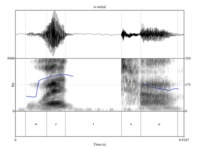 DBRw
-
 NSDw
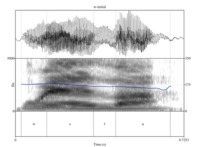
The voiced labio-velar approximant w [w] in word-initial position.
-
 NSDu
-
 LBDSu
-
 CLDSuH
-
 SSJMtth
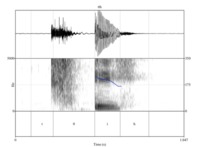
In this example, the phoneme is an interdental ejective affricate tth’.
-
 LBDStth
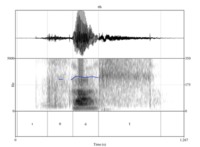
The aspirated interdental affricate tth [tθʰ] in word-initial position.
-
 CLDStth
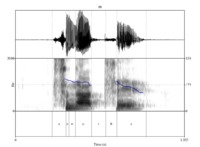
The aspirated interdental affricate tth [tθ] in stem-initial position between two vowels. This is a voiceless sound. The contrast between ddh [dð] and tth [tθ] is one of voicing in Dene Sųłiné.
-
 SSJMtth-
-
 LBDStth-
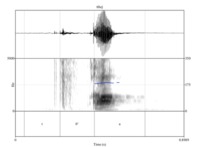
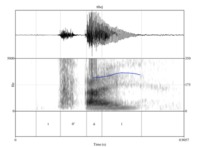
The interdental ejective affricate tth’ [tθ’] in word-initial position; note the characteristic ejective pattern.
-
 CLDStth-
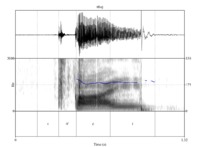
The ejective tth’ [tθ’] is a dental ejective affricate. This sound has the characteristic profile of a Dene ejective; the release of the stop is about halfway through the sound, visible in the waveform. Speakers sometimes describe this sound as having a click quality.
-
 DBRts
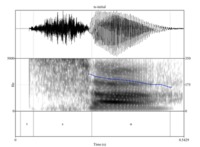
The voiceless alveolar affricate ts [tsʰ]. Note the lack of any voicing during the closure or release period of this sound in the waveform or spectrogram. Note also that the release (the fricative portion) is longer than it is in the unaspirated affricate dz [dz]. A characteristic aspect of this sound, standing in contrast to the unaspirated version, is found in the transition of the sound into the vowel portion. Note the change in the amplitude at the end of the release portion. One possible explanation is that the length distinction between aspirated and unaspirated affricates in the fricative portion is due in part to the presence of a phonation period (the dampened amplitude period) as a transition from the affricate to the vowel.
-
 SSJMts
-
 NSDts
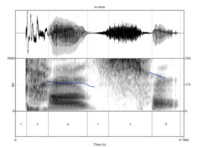
A good example of a Dene aspirated affricate. The aspiration appears at the end of the fricative part of the sound as it transitions into the vowel. This aspiration is clearly visible in the waveform and spectrogram. Contrast the aspirated release of this sound with its unaspirated counterpart dz [ts]. Observe also the compression of the closure period of the affricate; it is partially voiced and is quite short.
-
 LBDSts
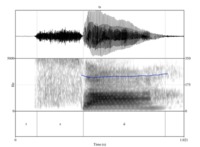
The aspirated alveolar affricate ts [tsʰ] in word-initial position. Note the shape and duration of the release period, and contrast it with the unaspirated alveolar affricate dz [dz], which is quite voiced.
-
 CLDSts
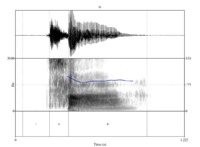
The voiceless alveolar affricate ts [tsʰ] in word-initial position. Contrast this with the unaspirated dz [dz], noting the differences in their release periods.
-
 DBRts-
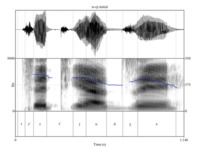
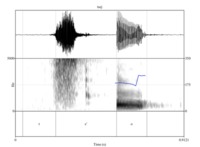
An alveolar affricate ejective ts' [ts'] in initial position in a word. This ejective is a weak ejective, there is only a slight period of silence between the fricative portion of the sound and the onset of the vowel. In both this and the following example, this sound ts' [ts'] is very similar to an aspirated alveolar affricate ts [tsʰ].
-
 SSJMts-
-
 NSDts-
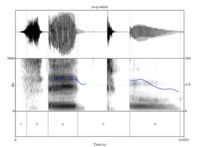
A word with two ejectives ts’ [ts’] and t’ [t’]. Both show the characteristic ejective pattern. In this example, ts’ [ts’] is in word-initial position; t’ [t’] is in stem-initial position.
-
 LBDSts-
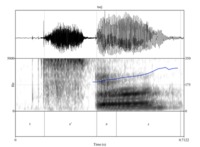
The ejective alveolar affricate ts’ [ts’] in word-initial position. Compare this to the other ejectives affricates; all tend to have a period of silence between the frication and the onset of the vowel.
-
 CLDSts-
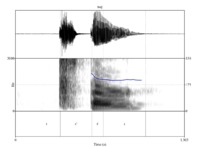
An example of the alveolar ejective ts’ [ts’] in word-initial position. Note the long break from the release of the oral closure to the onset of the vowel. The fricative portion of the affricate sound ends well before the onset of the vowel in a typical Dene ejective. This sound is unvoiced.
-
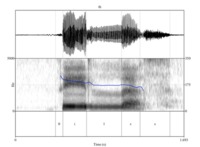 LBDSth
The interdental fricative th [θ] in word-initial position. Notice also the intervocalic lateral fricative l [l]; it is voiced throughout, and is articulated as an approximant.
-
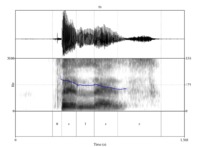 CLDSth
An example of the voiceless interdental fricative th [θ] in word-initial position.
-
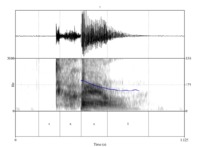 CLDSt
A t [tx] in initial position. Although this sound is written as t in the orthography, it is actually an affricate [tx], with a strong and clear fricated release. In this example, the release of the affricate is coarticulated with the vowel, giving it a slightly palatalized sound. This sound is voiceless.
-
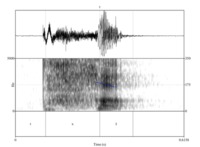 SSJMt
The alveolar affricate with velar release t [tx]. The long and strongly fricated release is characteristic of this sound across Dene languages.
-
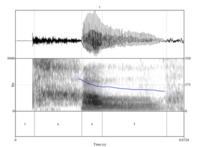 LBDSt
Although this sound is often characterized as an aspirated sound, it is an affricate. The affricated release is clearly visible in the waveform and spectrogram, and is an audible property of the sound.
-
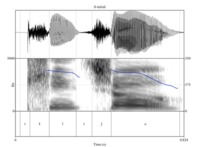 DBRtl
The voiceless lateral affricate tł [tɬʰ] in word-initial position. The fricative portion of the lateral is quite strong and similar to the lateral fricative ł [ɬ].
-
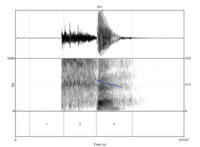 SSJMtl
-
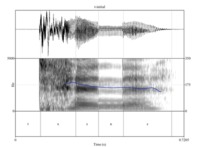 NSDt
This token of t [tx] exemplifies the sound as an alveolar stop followed by velar fricative. The velar fricative release is a distinctive property of this sound, and makes the sound quite unlike the English aspirated stop [tʰ]. The t [tx] shown here is in word-initial position.
-
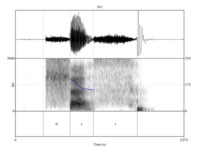 LBDStl
An aspirated lateral affricate tł [tɬʰ] in word-initial position. This sound is clearly voiceless; compare it with the voiced variant dl [dl].
-
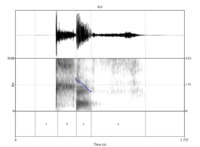 CLDStl
A voiceless aspirated alveolar affricate tł [tɬʰ] in word-initial position. Contrast the release period of this sound with that of dl [dl].
-
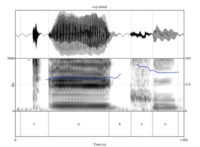 DBRt-
The alveolar ejective t’ [t’] in word-initial position. In this example, the oral release can be seen in the dark thick band of energy of the release burst, which is followed by a period of silence before the onset of the vowel. This "silence" is caused by a delay in the release of the glottal gesture of the ejective. The vowel begins at the glottal release, but the alveolar closure of the stop is released halfway through. This is called known as a "strong" ejective.
-
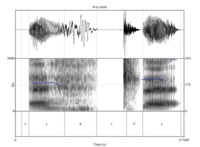 NSDtl-
An example of the lateral ejective affricate, in stem-initial and word medial-position followed by a glottal fricative. The boundary between these two segments is a major juncture in the word, a domain break between the stem and the pre-stem domains.
-
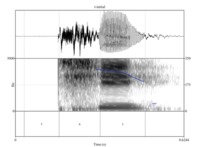 DBRt
This sound is a voiceless affricate with a coronal closure and a velar fricative release. The velar frication of the release period, seen below as the dark band that begins at the release of the closure of the stop, is clearly audible property of the sound. This realization of t as an affricate [tx] is a pattern that occurs across the Dene languages, especially strongly in Tłį Chǫ. Compare this Tłį Chǫ example to the examples of t [tx] in Dene Sųłine and North Slavey.
-
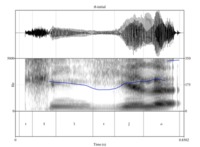 NSDtl
The aspirated lateral affricate tł [tɬʰ] in word-initial position. This sound is voiceless; the transition of the fricative portion into the vowel is a characteristic property of aspirated affricates. The lateral is a fricative; contrast this with the lateral approximant of the dl [dl].
-
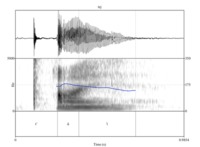 LBDSt-
The alveolar ejective t’ [t’] in word-initial position, showing the characteristic ejective pattern.
-
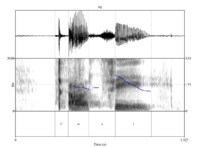 CLDSt-
The alveolar ejective t’ [t’] in word-initial position. The release of the stop occurs before the onset of the vowel, leaving a space between the release and the vowel onset that is characteristic of Dene ejectives.
-
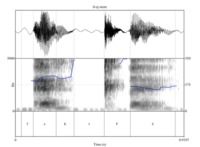 DBRtl-
The lateral ejective affricate in stem-initial position, showing the characteristic Dene ejective pattern.
-
 SSJMtl-
-
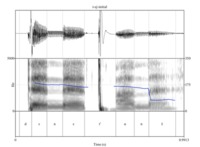 NSDt-
The alveolar ejective t’ [t’] in stem-initial position between two vowels. This as a characteristic example of the Dene ejective stop, with the release of the stop about halfway through the sound. Dene ejectives are voiceless, as ejectives commonly are.
-
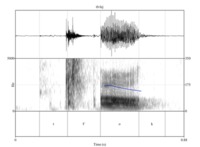 LBDStl-
An example of the alveolar lateral ejective affricate tł’ [tɬ'] in word-initial position, with the characteristic ejective pattern. This sound is voiceless.
-
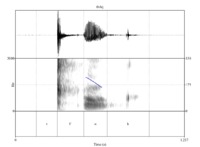 CLDStl-
An example of the alveolar lateral ejective affricate tł’ [tɬ’] in word-initial position. Like all Dene ejectives, this sound is voiceless.
-
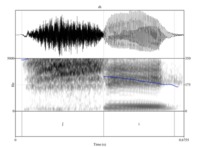 DBRsh
The voiceless post-alveolar fricative sh [ʃ] in word-initial position.
-
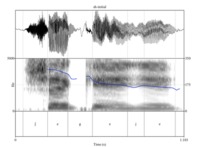 NSDsh
The voiceless post-alveolar fricative sh [ʃ] in word-initial position.
-
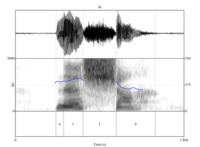 LBDSsh
The voiceless post-alveolar fricative sh [ʃ] in stem-initial position, between two vowels. This sound is voiceless.
-
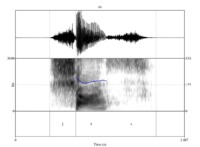 CLDSsh
The voiceless post-alveolar fricative sh [ʃ] in word-initial position. Contrast the strength of the frication in this sound with that of the s [s] at the end of the word.
-
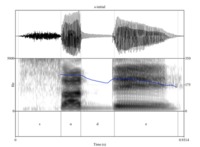 DBRs
The alveolar fricative s [s] in word-initial position.
-
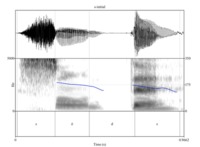 NSDs
The voiceless alveolar fricative s [s] in word-initial position. Note also the partially voiced d [t].
-
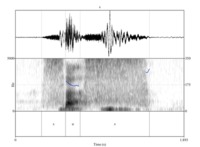 LBDSs
The voiceless alveolar fricative s [s] in word-initial and word-final position.
-
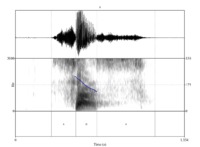 CLDSs
The voiceless alveolar fricative s [s] in both word-initial and word-final positions; in either position, this sound is voiceless.
-
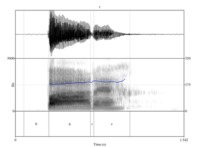 LBDSr
An example showing an intervocalic rhotic sound.
-
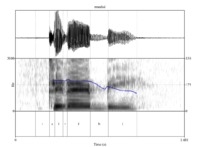 CLDSr
In this token, the r [ɹ] is intervocalic and quite short; compare this token with the following example.
-
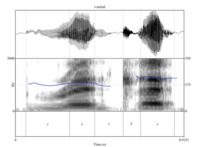 NSDr
The voiced alveolar rhotic r [ɹ] in word-initial position.
-
 DBRo
-
 NSDo
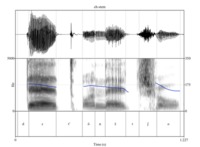
An example containing two instances of the mid back vowel o [o]; the first instance of o [o], following the alveolar ejective t’ [t’], is nasalized.
-
 LBDSo
-
 CLDSo
-
 DBRn
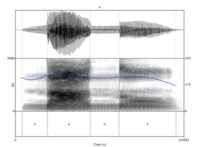
This example contains two alveolar nasals, one in word-initial position and one in word-medial position.
-
 NSDn
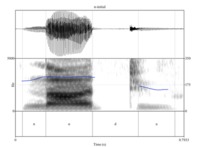
An example of the alveolar nasal n [n] in word-initial position.
-
 LBDSn
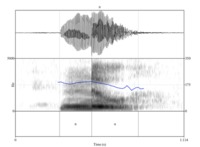
The alveolar nasal n [n] in word-initial position.
-
 CLDSn
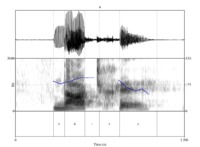
This word also exemplifies t [tx] in stem-initial position.
-
 DBRm
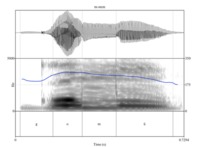
Note the long nasalized low tone vowel in the last syllable. The initial velar stop g [g] is voiced.
-
 SSJMm
-
 CLDSm
-
 DBRl
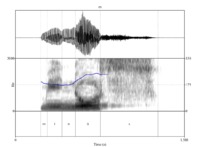
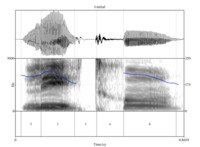
The voiced lateral approximant l [l] in word-initial position.
-
 NSDl
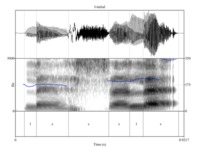
An example of the voiced lateral approximant l [l]. Though this sound is classified as a fricative in the phoneme inventory, it appears twice in this word as an approximant.
-
 LBDSl
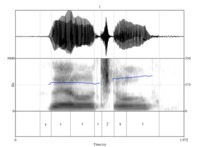
An example of a voiced lateral l [l] realized as an approximant in syllable-final position, before the stem-initial consonant ch’ [tʃ’]. This is clearly an approximant. The length of the segment is characteristic of consonants in this position in the word.
-
 CLDSl
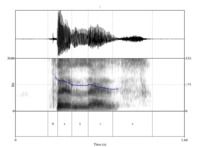
This is the voiced reflex of the lateral fricative. Although the laterals in general are understood to be fricatives, many of the voiced lateral fricatives are realized as approximants, as seen in this token.
-
 DBRkw
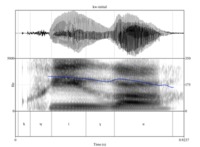
The voiceless labialized velar stop kw [kw̥] in word-initial position. The labialization is an audible property of the sound. Note the movement of the formant (dark energy band) during the labial release before the onset of the vowel. The labial offglide of this sound is voiceless.
-
 DBRkw-
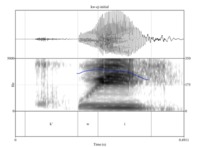
In both examples on this page, this sound is articulated as a velar ejective [k’] followed by a labio-velar glide [w]; that is, as the sequence [k’w] rather than as a labialized velar ejective [kw’]. The glide portion of this sound is voiced, and its formant structure (dark energy bands) is visible. Note the movement of the second formant is as it rises during the sound.
-
 NSDkw-
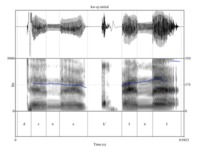
The labialized velar ejective kw’ [kw̥’] in stem-initial position.
-
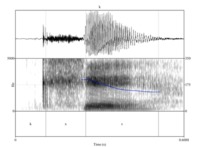 LBDSk
This sound is often described as an aspirated velar stop. It is a velar affricate [kx], with a strongly fricated release that is visible in the waveform of the spectrogram and is an audible property of the sound.
-
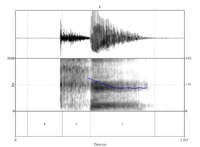 CLDSk
An example of the k [kx] sound in word-initial position. The sound is called an aspirated stop, but is more accurately described as an affricate with a strong velar fricative release. The fricative release is a clear and audible property of the sound.
-
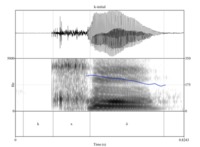 DBRk
A characteristic velar affricate k [kx] in word-initial position. The stop closure period is voiceless, followed by a voiceless frication period that is present in the spectrogram as a dark band of energy. The affrication is an audible property of the sound. This affricate has a similar pattern as the unaspirated alveolar affricate dz [dz].
-
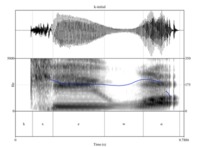 NSDk
The velar affricate k [kx] word-initially. This sound has been described as an aspirated plain stop, but it has the profile of an affricate. Its release is strongly fricated; this is an visible and audible property of the sound.
-
 LBDSk-
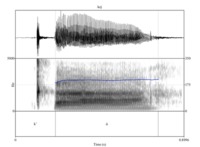
The velar ejective k’ [k’] in word-initial position, showing the characteristic ejective pattern visible in the waveform. Compare this with other ejectives t’ [t’], ts’ [ts’], and ch’ [tʃ’].
-
 CLDSk-
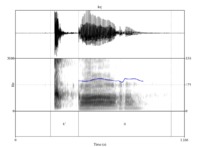
A characteristic example of the velar ejective k’ [k’] in word-initial position, with a strong release that ends well before the onset of the vowel.
-
 DBRk-
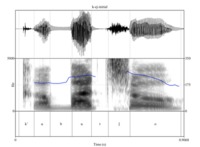
The velar ejective k’ [k’] in word-initial position.
-
 NSDk-
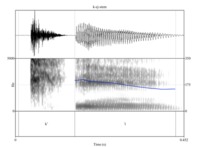
The velar ejective k’ [k’] in word-initial position, showing the characteristic ejective pattern. Compare this example to examples of other ejectives t’ [t’], ts’ [ts’], and ch’ [tʃ’], as well as the following example of k’ [k’] in word-medial position.
-
 DBRj
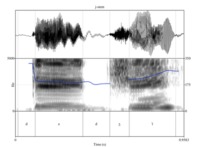
The j [dʒ] is voiced during the closure period in this example, but the fricative release is voiceless. Contrast this with the voiceless post-alveolar affricate ch [tʃʰ].
-
 NSDj
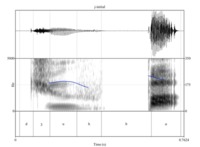
The unaspirated post-alveolar affricate j [tʃ] in word-initial position, here voiceless. Note also the duration of the stem-initial unaspirated bilabial stop b [b].
-
 LBDSj
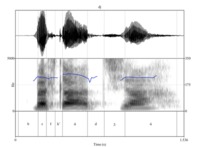
An intervocalic voiced alveolar affricate j [dʒ] in stem-initial position. The closure period is partially voiced. Compare its release period with the release period of the voiceless variant ch [tʃ].
-
 CLDSj
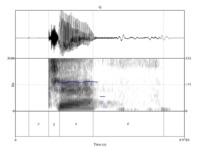
This token j [dʒ] is voiceless in this word, so it is actually a voiceless unaspirated affricate. It differs from ch [tʃʰ] in the length of the frication period. In this token, the frication period is short, and the vowel begins right at the end of the fricative portion of the sound. Compare this with dz [dz].
-
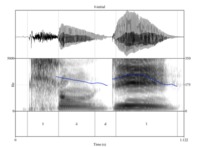 DBRlh
The voiceless lateral fricative ł [ɬ] in word-initial position.
-
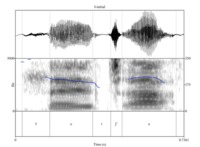 NSDlh
The voiceless lateral fricative ł [ɬ] in word-initial position. Note also the post-alveolar ejective affricate ch’ [tʃ’]; in this example, this sounds does not show the characteristic ejective pattern, and may be perceptually an aspirated affricate ch [tʃʱ] instead.
-
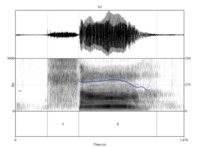 LBDSlh
An example of the voiceless lateral fricative ł [ɬ] in word-initial position. It is strongly fricated and voiceless. Contrast this with the release portion of the lateral affricates dl [dl] and tł [tɬʰ]. It is very similar in strength of its frication and in its duration to the affricate tł [tɬʰ].
-
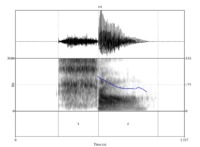 CLDSlh
A voiceless lateral fricative ł [ɬ] in word-initial position. This sound is very clearly voiceless, and articulated with strong frication.
-
 DBR-
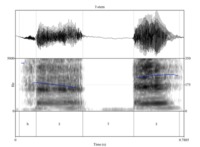
The glottal stop ’ [ʔ] in this example is very long, with a clear onset and offset and little, if any, laryngealization in the surrounding vowels.
-
 LBDS-
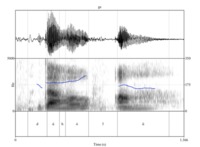
An example of a glottal stop ’ [ʔ] in stem-initial position. As with all stem-initial consonants, the closure period is quite long. There is some gloattlization in the following vowel, but not a great deal. Note the intervocalic h [h] in this example is realized as a voiced fricative; contrast this with the sounds h [h] and x [x~h], which are less fricative-like than h [h] in this token.
-
 DBRi
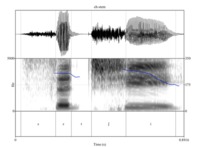
Notice the difference in the duration of the vowel in the first and second syllables. The last syllable in the word has a tendency to be quite prominent, likely related to its association with the stem position of the verb. Both of these vowels are carry high tone.
-
 NSDi
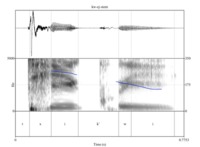
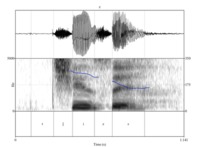
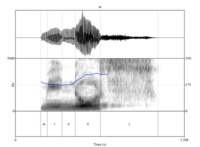
Examples of the high front vowel i [i~ɪ] with high tone (first syllable) and low tone (second syllable).
-
 LBDSi
-
 CLDSi
-
 DBRh
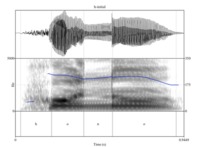
The glottal fricative h [h] in word-initial position.
-
 NSDh
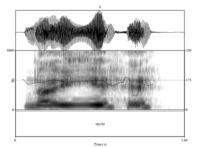
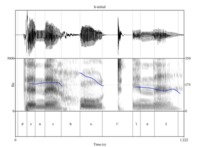
The glottal fricative h [h]. Note the falling tone on the long vowel following the glottal fricative, in contrast to the comparatively flat tone of the other syllables.
-
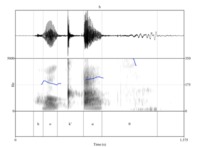 LBDSh
The glottal fricative h [h] in word-initial position. Note also the intervocalic ejective k’ [k’] in stem-initial position.
-
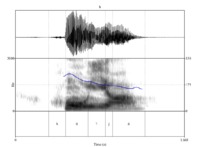 CLDSh
The glottal fricative h [h] in word-initial position. This sound is voiceless.
-
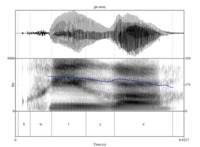 DBRgh
This is an example of a voiced velar fricative gh [ɣ] realized as an approximant between two vowels. This variant of the velar fricative is common across the Dene languages; see similar examples of this sound in Dene Sųłine and North Slavey.
-
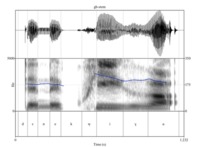 NSDgh
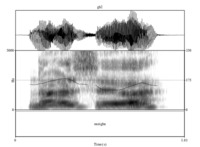
The intervocalic voiced velar fricative gh [ɣ], articulated here as an approximant. There is little energy in the higher frequencies, and clear formant structure. Compare this with n [n] is this example, which is also an approximant.
-
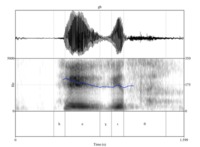 LBDSgh
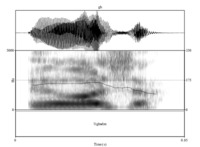
An intervocalic example of the voiced velar fricative gh [ɣ]. It is voiced throughout, and has approximant-like properties.
-
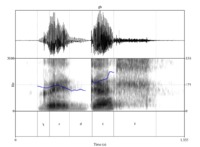 CLDSgh
The voiced velar fricative gh [ɣ] in word initial position. Note that the d [d] phomene is fully voiced in the stem-initial position in this word.
-
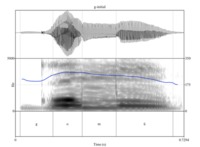 DBRg
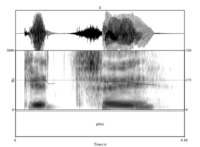
A strongly voiced velar stop g [g] in word-initial position. Contrast the voicing of this token with that of the second example below.
-
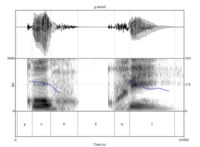 NSDg
The voiceless velar stop g [k] in word-initial position; it is voiceless. Other unaspirated stops in the language also tend to be voiceless; see b [p] and d [t].
-
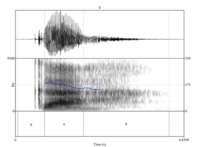 LBDSg
In this token, the g [g] is in word-initial position, and is not voiced. Contrast this with the voicing in the d [d] and dz [dz].
-
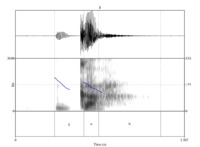 CLDSg
The g [g] phoneme in word-initial position. This is a voiced sound, although it is less voiced than d [d] or b [b].
-
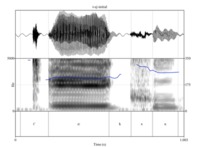 DBRe
-
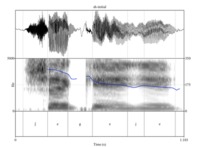 NSDe
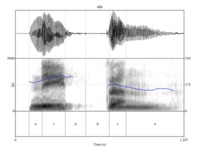
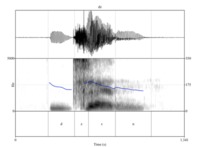
An example with three instances of e [e~ɛ]; the first carries high tone, while the second two carry low tone. The mid front vowel is the most common vowel in the dataset, and is also the most common prefix vowel, as well as being the most dispersed vowel in the vowel space.
-
 LBDSe
-
 CLDSe
-
 DBRdz
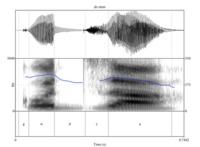
The voiced alveolar affricate dz [dz] in intervocalic and stem-initial position. The closure period is voiced; this is seen in the waveform and in the voicing bar at the bottom of the spectrogram. The release period, the fricative, is only partially voiced. A small release burst, the release of the [d] closure, is visible halfway through the segment at the beginning of the fricative [z] portion. Stem-initial position is a strong position for phoneme sounds. It is proper to call this segment a voiced affricate, though there is a good deal of variation in its voicing across speakers and across tokens.
-
 NSDdz
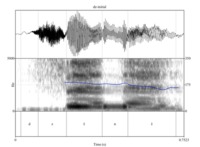
The voiceless alveolar affricate dz [ts] in word-initial position. It differs from the aspirated version ts [tsʰ] in the duration of its release and in its movement directly into a vowel without an aspiration period.
-
 LBDSdz
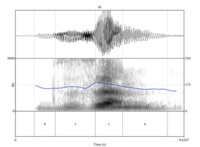
A voiced alveolar affricate dz [dz] in word-initial position. This sound is fully voiced.
-
 CLDSdz
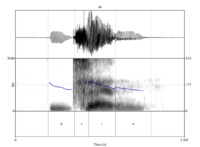
This token of dz [dz] is voiced; the closure period is strongly voiced but the release period is voiceless, as is characteristic for these sounds.
-
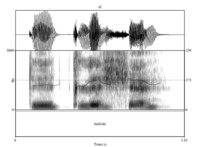
 DBRdl
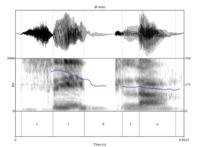
The voiced lateral affricate dl [dl] in stem-initial position between two vowels. This sound is voiced most of the way through the closure and release period. Note also that the release portion of this sound, the lateral [l] portion, is articulated as a fricative during the voiceless portion of the sound at the very beginning of the release period, after which it is voiced and appears as a lateral approximant. The distinction between the two realizations of the release is distinguishable in the waveform and in the spectrogram. This change between the lateral fricative and a lateral approximant is found throughout the Dene languages when voicing is present.
-
 NSDdl
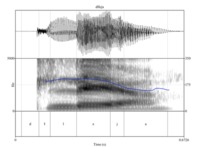
The unaspirated lateral affricate dl [tɬ] with a partially voiced release. Note that the release portion begins as a voiced fricative, but then transitions to an approximant. The transition is clearly visible in the waveform and spectrogram.
-
 LBDSdl
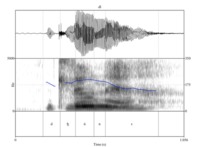
The voiced alveolar lateral affricate dl [dl] in word-initial position. This waveform of this token exemplifies a pattern that is not uncommon in the artiuclation of this sound: the sound starts of as a voiceless lateral fricative and then becomes voiced. The sound has voicing in the closure period, visible in both the waveform and spectrogram near the end of the sound in the fricative release. Cross linguistically, it is not uncommon for a voiced lateral fricative to become an approximant.
-
 CLDSdl
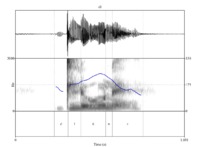
An example of the fully voiced lateral affricate dl [dl] in word-initial position. The lateral release has qualities of an approximant; the release has a formant structure.
-
 LBDSdh
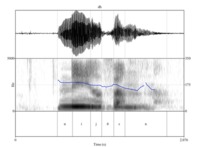
An intervocalic voiced interdental fricative dh [ð] in stem-initial position.
-
 CLDSdh
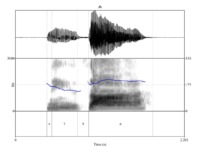
The interdental fricative dh [ð] between two vowels. This sound is only slightly voiced.
-
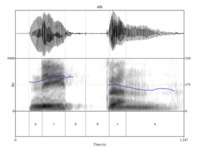 LBDSddh
The voiced interdental affricate ddh [dð] intervocalically and in stem-initial position. In this token, it is only partially voiced.
-
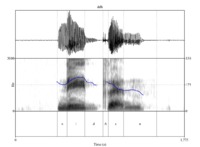 CLDSddh
An example of ddh [dð] in stem-initial position, between two vowels. The sound in this example is voiced.
-
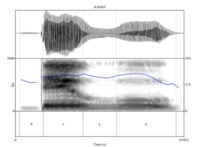 DBRd
The initial alveolar stop d [d] is voiced all the way through the articulation of the sound; it is a fully voiced stop. The voicing during the closure period can be seen in both the waveform and spectrogram. A small stop burst can also be seen in the waveform and the spectrogram, followed by the onset of voicing in the vowel.
-
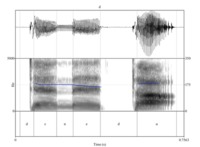 NSDd
The unaspirated alveolar stop d [t] in word-initial and stem-initial position. In both occurrences, the stop is voiceless, and the following vowel beings immediately after the stop release.
-
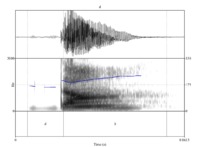 LBDSd
The voiced alveolar stop d [d] is voiced in this example. Contrast this with b [b] for examples of variation in the articulation of this sound.
-
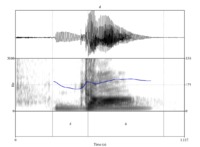 CLDSd
The phoneme d [d] in word-initial position. This a strongly voiced stop; voicing is visible all the way through the stop closure. Contrast the voicing of this stop with the bilabial b [b] example; the token here is more strongly voiced.
-
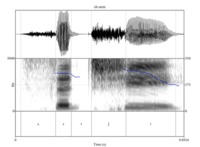 DBRch
A voiceless post-alveolar affricate ch [tʃʰ] in stem-initial, intervocalic position. The closure period of this token is partly voiced, but the fricative release is voiceless. Notice that the release portion of this segment is significantly longer than the closure. This is a characteristic pattern across the Dene languages.
-
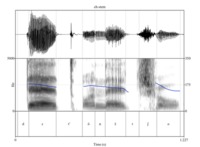 NSDch
The aspirated post-alveolar affricate ch [tʃʰ] in stem-initial position between two vowels. Contrast the transition of the fricative release into the vowel with the fricative release of the unaspirated version j [tʃ]. This token also contains an example of an ejective t’ [t’], with the characteristic ejective pattern.
-
 LBDSch
The aspirated post-alveolar affricate ch [tʃʰ] in word-initial position. This sound is voiceless and has a long release period, with a small period of aspiration before the vowel.
-
 CLDSch
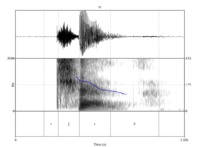
An example of the affricate ch [tʃʰ] in word-initial position. The frication period of this sound is voiceless, and the fricative ends with a small period of aspiration right before the onset of the vowel. Note the difference between this sound and the j [dʒ] phoneme in length and type of release period.
-
 DBRch-
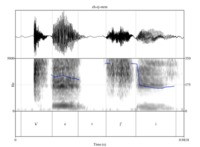
This example contains two ejectives, the velar ejective k’ [k’] and the post-alveolar ejective affricate ch’ [tʃ’]. The two share similar profiles in terms of closure, silence, and release periods.
-
 SSJMch-
-
 NSDch-
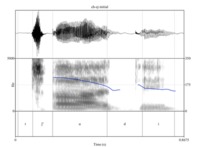
The post-alveolar ejective affricate ch’ [tʃ'] in word-initial position, showing the characteristic Dene ejective pattern.
-
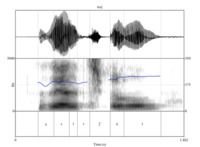 LBDSch-
The post-alveolar ejective affricate ch’ [tʃ’] in stem-initial position between two vowels. This token demonstrates a common characteristic of affricates: the closure period, rather than the release period, is compressed in this position. The release period maintains its duration and quality.
-
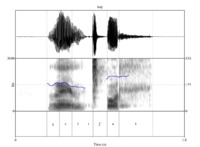 CLDSch-
An example of ejective affricate ch’ [tʃ’] in stem-initial position. The characteristic ejective profile is present and can also be seen in the t’ [t’], k’ [k’], ts’ [ts’] and tł’ [tɬ’] sounds.
-
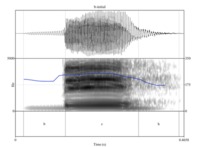 DBRb
The bilabial stop b [b] in this example is in initial position and is strongly voiced all the way through the sound.
-
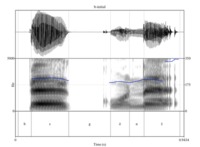 NSDb
The unaspirated bilabial stop b [p] in word initial-position. This sound is voiceless; note also the voicelessness of the stem-initial stop g [k].
-
 LBDSb
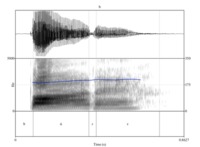
The stop b [b] in this token is not voiced. This kind of variation in the voicing of these sounds is not uncommon; see the example paired with g [g]. However, these sounds are commonly strongly voiced, and are thus represented in the IPA as voiced stops, to contrast them with completely voiceless stops in other Dene languages.
-
 CLDSb
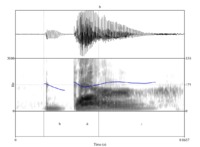
The phoneme b [b] in word-initial position; the voicing bar is visible in the waveform.
-
 DBRa
-
 NSDa
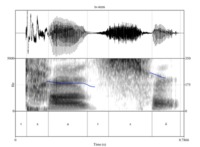
The low back vowel a [ɑ] with low tone. Note the initial t [tx], with strong velar frication in the release, and the compression of the closure portion of the affricate in the medial ts [tsʰ].
-
 LBDSa
-
 CLDSaH
-
 CLDSa
