-
 LBDSuH
-
 LBDSoH
-
 LBDSiN
-
 LBDSiH
-
 LBDSeH
-
 LBDSaN
-
 LBDSaH
-
 LBDSz
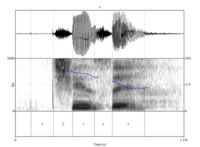
The voiced alveolar fricative z [z] between two vowels. In this token, it is only partially voiced. Contrast this with the voiceless alveolar fricative s [s] and with the fricative release of the affricate dz [dz] in word-initial position.
-
 LBDSy
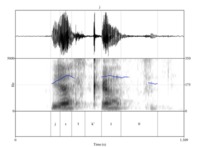
This is a palatal glide y in word initial position. Segmentation between this sound and the following mid front vowel is difficult and done mostly by formant structure.
-
 LBDSx
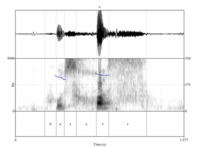
The phoneme x [x~h] in word-initial position. This sound is realized as a glottal fricative [h] rather than a velar fricative [x]; there is very little evidence of the oral constriction necessary for a velar fricative. Contrast this with the glottal fricative h [h] in this token, as well as with the release of the stops t [tx] and k [kx], which show strong velar frication.
-
 LBDSu
-
 LBDStth
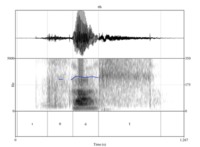
The aspirated interdental affricate tth [tθʰ] in word-initial position.
-
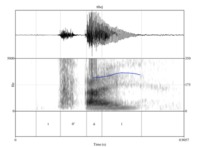 LBDStth-
The interdental ejective affricate tth’ [tθ’] in word-initial position; note the characteristic ejective pattern.
-
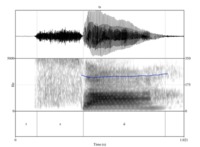 LBDSts
The aspirated alveolar affricate ts [tsʰ] in word-initial position. Note the shape and duration of the release period, and contrast it with the unaspirated alveolar affricate dz [dz], which is quite voiced.
-
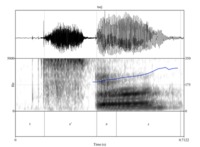 LBDSts-
The ejective alveolar affricate ts’ [ts’] in word-initial position. Compare this to the other ejectives affricates; all tend to have a period of silence between the frication and the onset of the vowel.
-
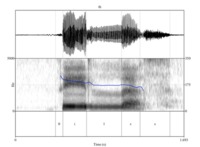 LBDSth
The interdental fricative th [θ] in word-initial position. Notice also the intervocalic lateral fricative l [l]; it is voiced throughout, and is articulated as an approximant.
-
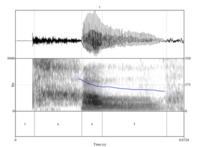 LBDSt
Although this sound is often characterized as an aspirated sound, it is an affricate. The affricated release is clearly visible in the waveform and spectrogram, and is an audible property of the sound.
-
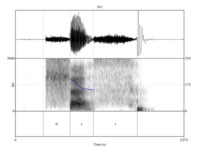 LBDStl
An aspirated lateral affricate tł [tɬʰ] in word-initial position. This sound is clearly voiceless; compare it with the voiced variant dl [dl].
-
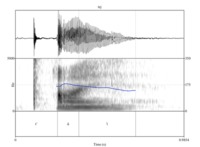 LBDSt-
The alveolar ejective t’ [t’] in word-initial position, showing the characteristic ejective pattern.
-
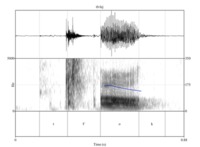 LBDStl-
An example of the alveolar lateral ejective affricate tł’ [tɬ'] in word-initial position, with the characteristic ejective pattern. This sound is voiceless.
-
 LBDSsh
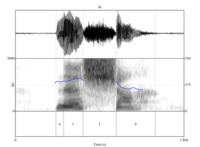
The voiceless post-alveolar fricative sh [ʃ] in stem-initial position, between two vowels. This sound is voiceless.
-
 LBDSs
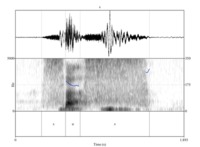
The voiceless alveolar fricative s [s] in word-initial and word-final position.
-
 LBDSr
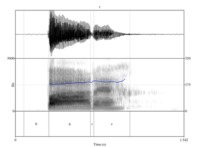
An example showing an intervocalic rhotic sound.
-
 LBDSo
-
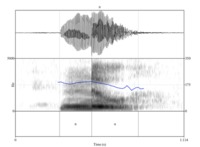 LBDSn
The alveolar nasal n [n] in word-initial position.
-
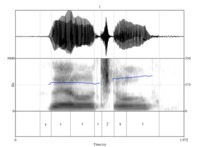 LBDSl
An example of a voiced lateral l [l] realized as an approximant in syllable-final position, before the stem-initial consonant ch’ [tʃ’]. This is clearly an approximant. The length of the segment is characteristic of consonants in this position in the word.
-
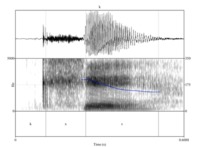 LBDSk
This sound is often described as an aspirated velar stop. It is a velar affricate [kx], with a strongly fricated release that is visible in the waveform of the spectrogram and is an audible property of the sound.
-
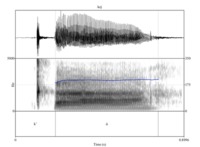 LBDSk-
The velar ejective k’ [k’] in word-initial position, showing the characteristic ejective pattern visible in the waveform. Compare this with other ejectives t’ [t’], ts’ [ts’], and ch’ [tʃ’].
-
 LBDSj
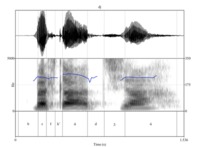
An intervocalic voiced alveolar affricate j [dʒ] in stem-initial position. The closure period is partially voiced. Compare its release period with the release period of the voiceless variant ch [tʃ].
-
 LBDSlh
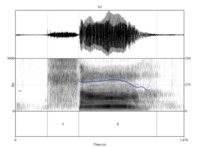
An example of the voiceless lateral fricative ł [ɬ] in word-initial position. It is strongly fricated and voiceless. Contrast this with the release portion of the lateral affricates dl [dl] and tł [tɬʰ]. It is very similar in strength of its frication and in its duration to the affricate tł [tɬʰ].
-
 LBDS-
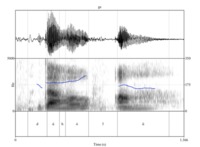
An example of a glottal stop ’ [ʔ] in stem-initial position. As with all stem-initial consonants, the closure period is quite long. There is some gloattlization in the following vowel, but not a great deal. Note the intervocalic h [h] in this example is realized as a voiced fricative; contrast this with the sounds h [h] and x [x~h], which are less fricative-like than h [h] in this token.
-
 LBDSi
-
 LBDSh
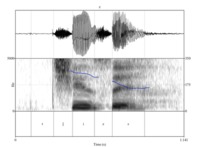
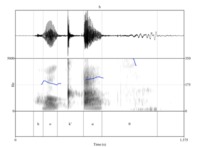
The glottal fricative h [h] in word-initial position. Note also the intervocalic ejective k’ [k’] in stem-initial position.
-
 LBDSgh
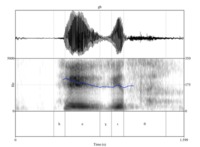
An intervocalic example of the voiced velar fricative gh [ɣ]. It is voiced throughout, and has approximant-like properties.
-
 LBDSg
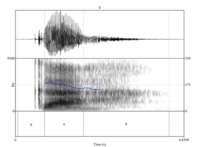
In this token, the g [g] is in word-initial position, and is not voiced. Contrast this with the voicing in the d [d] and dz [dz].
-
 LBDSe
-
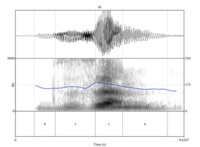 LBDSdz
A voiced alveolar affricate dz [dz] in word-initial position. This sound is fully voiced.
-
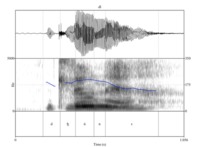 LBDSdl
The voiced alveolar lateral affricate dl [dl] in word-initial position. This waveform of this token exemplifies a pattern that is not uncommon in the artiuclation of this sound: the sound starts of as a voiceless lateral fricative and then becomes voiced. The sound has voicing in the closure period, visible in both the waveform and spectrogram near the end of the sound in the fricative release. Cross linguistically, it is not uncommon for a voiced lateral fricative to become an approximant.
-
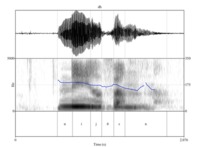 LBDSdh
An intervocalic voiced interdental fricative dh [ð] in stem-initial position.
-
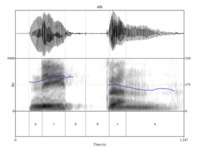 LBDSddh
The voiced interdental affricate ddh [dð] intervocalically and in stem-initial position. In this token, it is only partially voiced.
-
 LBDSd
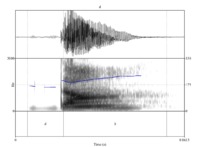
The voiced alveolar stop d [d] is voiced in this example. Contrast this with b [b] for examples of variation in the articulation of this sound.
-
 LBDSch
The aspirated post-alveolar affricate ch [tʃʰ] in word-initial position. This sound is voiceless and has a long release period, with a small period of aspiration before the vowel.
-
 LBDSch-
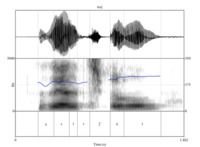
The post-alveolar ejective affricate ch’ [tʃ’] in stem-initial position between two vowels. This token demonstrates a common characteristic of affricates: the closure period, rather than the release period, is compressed in this position. The release period maintains its duration and quality.
-
 LBDSb
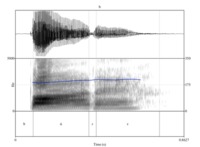
The stop b [b] in this token is not voiced. This kind of variation in the voicing of these sounds is not uncommon; see the example paired with g [g]. However, these sounds are commonly strongly voiced, and are thus represented in the IPA as voiced stops, to contrast them with completely voiceless stops in other Dene languages.
-
 LBDSa
