-
 DBRz
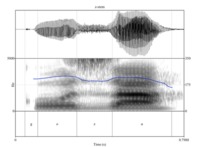
The voiced alveolar fricative z [z] in intervocalic position. It is voiced all the way through the sound. In this example, it is almost lenited to an approximant-like sound, and shows formant structure.
-
 DBRy
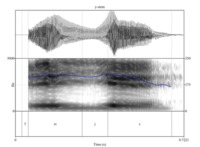
Note the falling tone on the final syllable, particularly distinguishable in this word spoken in isolation.
-
 DBRx
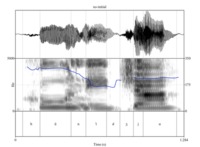
A voiceless velar fricative x [x] in word-initial position; in this example, it is realized as a glottal fricative [h].
-
 DBRwh
-
 DBRw
-
 DBRts
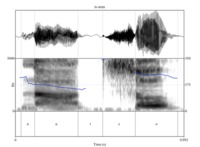
The voiceless alveolar affricate in intervocalic position. Note the lack of voicing and the length of the release (fricative) portion of the sound.
-
 DBRts-
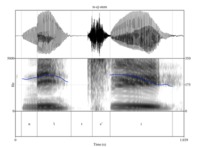
The alveolar ejective affricate in word-medial position. In this example, this sound is very similar to the alveolar ejective t’ [t’].
-
 DBRtl
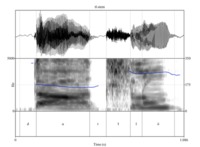
The voiceless lateral affricate in stem-initial, intervocalic position.
-
 DBRt-
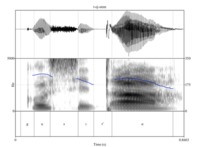
The ejective t’ [t’] in word-medial position. This is an example of a "weak" ejective. Unlike the characteristic t’ [t’] sound, in this example, the glottal release of the t’ [t’] ejective comes closely after its oral release, the release burst is followed closely by the onset of the vowel. This sound may be perceived as a voiced alveolar stop d [d].
-
 DBRt
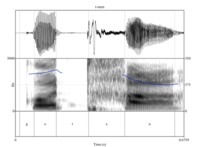
The affricate t [tx] in word-medial and stem-initial position. Note the long length of the fricative release of the affricate. The vowel begins directly after the fricative release. Contrast this release with examples of the Tłį Chǫ aspirated alveolar affricate ts [tsʰ]; they have very similar profiles.
-
 DBRtl-
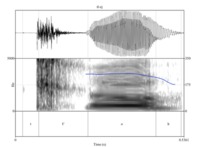
Another example of the lateral ejective affricate tł’ [tɬ’].
-
 DBRoNH
-
 DBRo
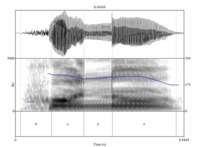
The tone on the first syllable falls only slightly but has the contour of a falling tone.
-
 DBRl
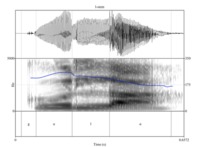
The voiced lateral approximant in word-medial, stem-initial position. In this example, the sonorant-type structure is visible in the formants in the spectrogram.
-
 DBRkw
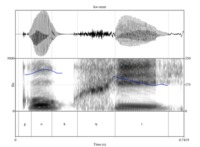
The voiceless labialized velar stop between two vowels. Note that the closure period is shorter than the labial release period. Also note the formant movement during the release. This is likely the second formant (no first formant is present), a result of the tongue position moving from the back (near the velum) to a more front position for the high front vowel i [i].
-
 DBRkw-
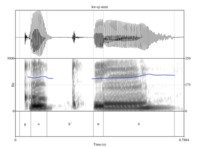
An intervocalic example of kw’, which is realized in these examples as a characteristic velar ejective [k’] followed by a labio-velar glide [w]. In this example, the labio-velar glide clearly follows the ejective k’ [k’w]. Note also that the velar stop g [g] in initial position is voiceless.
-
 DBRk
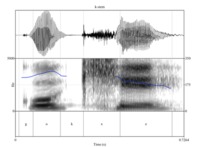
The velar affricate k [kx] between two vowels. The length and strength of the frication period is clear in the spectrogram and is a strong and audible property of the sound. Voicing continues briefly into the closure period of the sound, but the closure and release periods are voiceless. Note also that the initial velar stop g [g] is voiceless.
-
 DBRk-
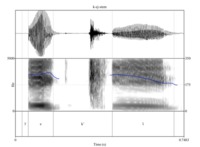
An intervocalic example of the velar ejective k’ [k’]. This sound has a long closure period, followed by a robust release burst which appears as a dark energy band. The glottal release occurs well after the release of the oral closure, resulting in the characteristic "period of silence" during the articulation of this sound. This also contributes to the sharp onset of the vowel. Note that the glottal stop in initial position is followed by a sharp onset of the vowel without any laryngealization; there is a very clean (non-laryngealized) transition from glottal closure to modal vowel. This is not an uncommon feature in Dene languages.
-
 DBRj
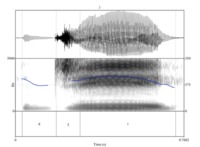
The voiced post-alveolar affricate j [dʒ] in word-initial position. It is voiced during both the closure and release portions of the sound.
-
 DBRlh
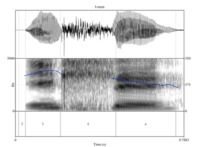
The voiceless lateral fricative ł [ɬ] in word-medial position.
-
 DBRiL
-
 DBRh
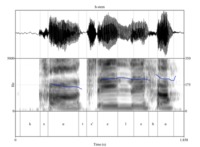
The glottal fricative h [h] in stem-initial position.
-
 DBRg
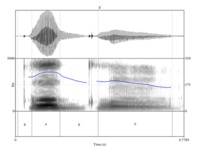
This word contains two examples of the velar plosive g [g]. In this token, the g is not voiced in initial position (as it is in the example above). However, the intervocalic g is strongly voiced. In all three example of the voiced velar stop g [g] on this page, the release burst is clearly visible as a spike in the spectrogram. The release bursts of velar fricatives often contain a double burst spike that is especially clear in the intervocalic example.
-
 DBRe
-
 DBRe
-
 DBRdz
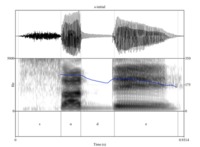
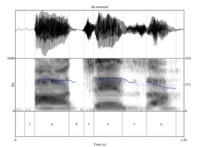
The alveolar affricate dz [dz] in intervocalic position. Compared to the last example, the affricate in this token is less voiced. Note the difference in the transition from the fricative portion of the sound to the vowel in this example as compared to that in the ts [tsʰ] examples.
-
 DBRd
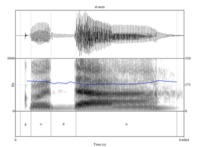
The voiced alveolar stop d [d] in intervocalic position. The vowel begins immediately after the release of the stop. Notice the difference between the g [g] in initial position and the d [d] in intervocalic position; the initial g [g] is not voiced in this token. This kind of variation is not uncommon for voiced stops.
-
 DBRb
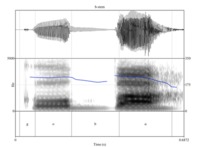
The bilabial stop b [b] in this example is in medial position between two vowels. It is strongly voiced. Compare this to a North Slavey b [p], which is voiceless rather than voiced.
-
 DBRa
-
 DBRz
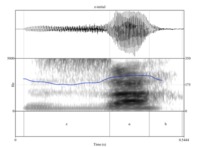
The voiced alveolar fricative z [z] is voiced all the way through the sound and contrasts with the voiceless s [s].
-
 DBRy
-
 DBRx
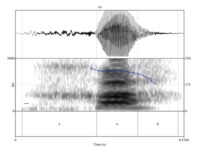
A voiceless velar fricative in word-initial position.
-
 DBRwh
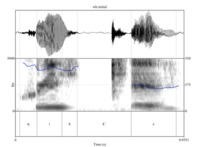
This token is voiceless, but still retains sonorant-type properties; a formant is still visible in the spectrogram.
-
 DBRw
-
 DBRts
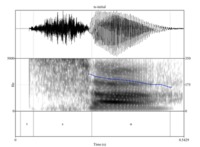
The voiceless alveolar affricate ts [tsʰ]. Note the lack of any voicing during the closure or release period of this sound in the waveform or spectrogram. Note also that the release (the fricative portion) is longer than it is in the unaspirated affricate dz [dz]. A characteristic aspect of this sound, standing in contrast to the unaspirated version, is found in the transition of the sound into the vowel portion. Note the change in the amplitude at the end of the release portion. One possible explanation is that the length distinction between aspirated and unaspirated affricates in the fricative portion is due in part to the presence of a phonation period (the dampened amplitude period) as a transition from the affricate to the vowel.
-
 DBRts-
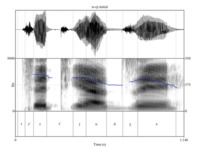
An alveolar affricate ejective ts' [ts'] in initial position in a word. This ejective is a weak ejective, there is only a slight period of silence between the fricative portion of the sound and the onset of the vowel. In both this and the following example, this sound ts' [ts'] is very similar to an aspirated alveolar affricate ts [tsʰ].
-
 DBRtl
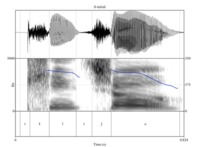
The voiceless lateral affricate tł [tɬʰ] in word-initial position. The fricative portion of the lateral is quite strong and similar to the lateral fricative ł [ɬ].
-
 DBRt-
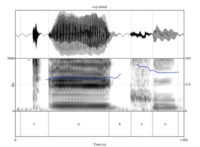
The alveolar ejective t’ [t’] in word-initial position. In this example, the oral release can be seen in the dark thick band of energy of the release burst, which is followed by a period of silence before the onset of the vowel. This "silence" is caused by a delay in the release of the glottal gesture of the ejective. The vowel begins at the glottal release, but the alveolar closure of the stop is released halfway through. This is called known as a "strong" ejective.
-
 DBRt
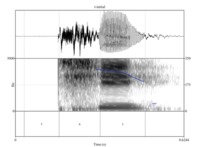
This sound is a voiceless affricate with a coronal closure and a velar fricative release. The velar frication of the release period, seen below as the dark band that begins at the release of the closure of the stop, is clearly audible property of the sound. This realization of t as an affricate [tx] is a pattern that occurs across the Dene languages, especially strongly in Tłį Chǫ. Compare this Tłį Chǫ example to the examples of t [tx] in Dene Sųłine and North Slavey.
-
 DBRtl-
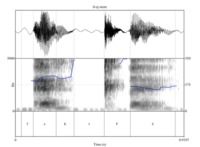
The lateral ejective affricate in stem-initial position, showing the characteristic Dene ejective pattern.
-
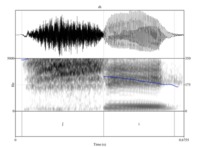 DBRsh
The voiceless post-alveolar fricative sh [ʃ] in word-initial position.
-
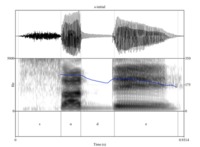 DBRs
The alveolar fricative s [s] in word-initial position.
-
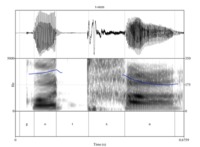 DBRo
-
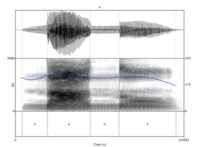 DBRn
This example contains two alveolar nasals, one in word-initial position and one in word-medial position.
-
 DBRm
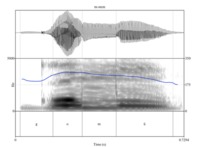
Note the long nasalized low tone vowel in the last syllable. The initial velar stop g [g] is voiced.
-
 DBRl
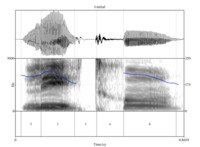
The voiced lateral approximant l [l] in word-initial position.
-
 DBRkw
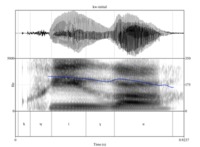
The voiceless labialized velar stop kw [kw̥] in word-initial position. The labialization is an audible property of the sound. Note the movement of the formant (dark energy band) during the labial release before the onset of the vowel. The labial offglide of this sound is voiceless.
-
 DBRkw-
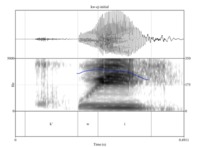
In both examples on this page, this sound is articulated as a velar ejective [k’] followed by a labio-velar glide [w]; that is, as the sequence [k’w] rather than as a labialized velar ejective [kw’]. The glide portion of this sound is voiced, and its formant structure (dark energy bands) is visible. Note the movement of the second formant is as it rises during the sound.
-
 DBRk
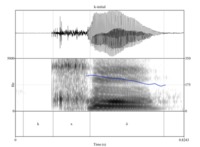
A characteristic velar affricate k [kx] in word-initial position. The stop closure period is voiceless, followed by a voiceless frication period that is present in the spectrogram as a dark band of energy. The affrication is an audible property of the sound. This affricate has a similar pattern as the unaspirated alveolar affricate dz [dz].
-
 DBRk-
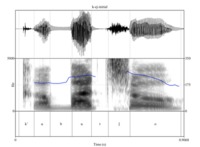
The velar ejective k’ [k’] in word-initial position.
-
 DBRj
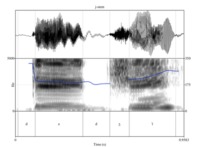
The j [dʒ] is voiced during the closure period in this example, but the fricative release is voiceless. Contrast this with the voiceless post-alveolar affricate ch [tʃʰ].
-
 DBRlh
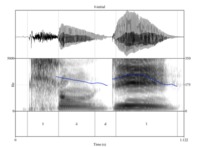
The voiceless lateral fricative ł [ɬ] in word-initial position.
-
 DBR-
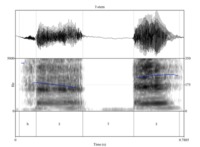
The glottal stop ’ [ʔ] in this example is very long, with a clear onset and offset and little, if any, laryngealization in the surrounding vowels.
-
 DBRi
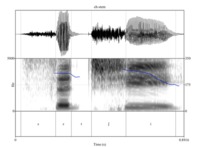
Notice the difference in the duration of the vowel in the first and second syllables. The last syllable in the word has a tendency to be quite prominent, likely related to its association with the stem position of the verb. Both of these vowels are carry high tone.
-
 DBRh
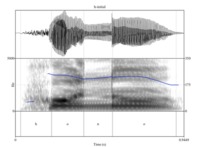
The glottal fricative h [h] in word-initial position.
-
 DBRgh
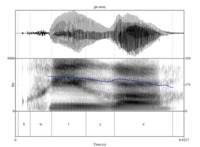
This is an example of a voiced velar fricative gh [ɣ] realized as an approximant between two vowels. This variant of the velar fricative is common across the Dene languages; see similar examples of this sound in Dene Sųłine and North Slavey.
-
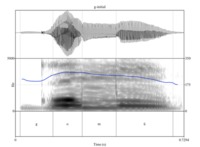 DBRg
A strongly voiced velar stop g [g] in word-initial position. Contrast the voicing of this token with that of the second example below.
-
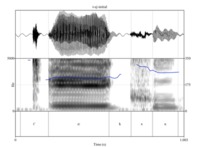 DBRe
-
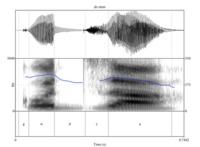 DBRdz
The voiced alveolar affricate dz [dz] in intervocalic and stem-initial position. The closure period is voiced; this is seen in the waveform and in the voicing bar at the bottom of the spectrogram. The release period, the fricative, is only partially voiced. A small release burst, the release of the [d] closure, is visible halfway through the segment at the beginning of the fricative [z] portion. Stem-initial position is a strong position for phoneme sounds. It is proper to call this segment a voiced affricate, though there is a good deal of variation in its voicing across speakers and across tokens.
-
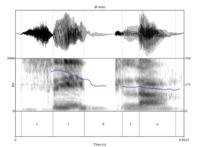 DBRdl
The voiced lateral affricate dl [dl] in stem-initial position between two vowels. This sound is voiced most of the way through the closure and release period. Note also that the release portion of this sound, the lateral [l] portion, is articulated as a fricative during the voiceless portion of the sound at the very beginning of the release period, after which it is voiced and appears as a lateral approximant. The distinction between the two realizations of the release is distinguishable in the waveform and in the spectrogram. This change between the lateral fricative and a lateral approximant is found throughout the Dene languages when voicing is present.
-
 DBRd
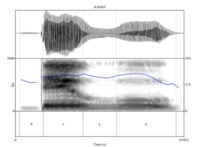
The initial alveolar stop d [d] is voiced all the way through the articulation of the sound; it is a fully voiced stop. The voicing during the closure period can be seen in both the waveform and spectrogram. A small stop burst can also be seen in the waveform and the spectrogram, followed by the onset of voicing in the vowel.
-
 DBRch
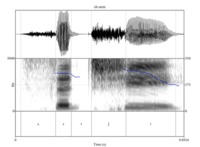
A voiceless post-alveolar affricate ch [tʃʰ] in stem-initial, intervocalic position. The closure period of this token is partly voiced, but the fricative release is voiceless. Notice that the release portion of this segment is significantly longer than the closure. This is a characteristic pattern across the Dene languages.
-
 DBRch-
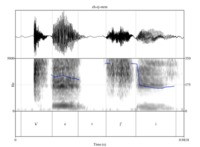
This example contains two ejectives, the velar ejective k’ [k’] and the post-alveolar ejective affricate ch’ [tʃ’]. The two share similar profiles in terms of closure, silence, and release periods.
-
 DBRb
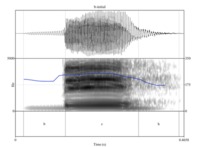
The bilabial stop b [b] in this example is in initial position and is strongly voiced all the way through the sound.
-
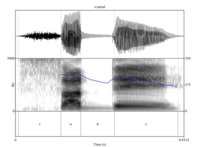 DBRa
